If you spend enough time around distributed systems, you’ll eventually hear about the CAP Theorem.It sounds abstract at first, but the core idea is simple:
When a distributed system is split by a network failure, you can’t fully guarantee both Consistency and Availability at the same time.
And honestly, One Piece is a perfect way to understand why.The World Government rules the seas with one weapon above all others that is information.Who is where,what their bounty is, which pirate crew is rising, which Warlord has gone rougue. The intelligence network is their true power. And likely every distributed systems, it has its own cracks.

Chapter 1: The Single Transponder Snail.
In the early days, all intelligence flowed through a single enormous Transponder Snail at Marineford HQ.One Veteran Operator let’s call her Officer Hana, managed the master ledger. Every bounty update,every pirate sighting, every ship movement was recorded by her and only her.The system was perfect in one way; everyone got the same answer.If you called asking about Gold Roger’s Bounty,Hana told you. If you called an hour later, same answer.One ledger,One Truth.
But the Grandline spans four Blues and two massive seas. Hand worked 18 hours a day. Ships waited weeks for bounty confirmation. When a fever put her in bed for ten days, the entire World Government’s intelligence operation ground to a halt. No bounties confirmed. No threat levels updated. Pirates had a field day.Fleet Admiral Sengoku declared : “We need a distributed network, one snail is not enough”
Chapter 2: Five Regional Bases - World Goverment scales up.
Five Marine Regional Command Centers were established, each with their own operator, their own Transponder Snail, and their own copy of the bounty ledger. Updates were relayed between bases once a day via long-range Den Den Mushi calls.Looked great on paper. Then the problems started almost immediately.
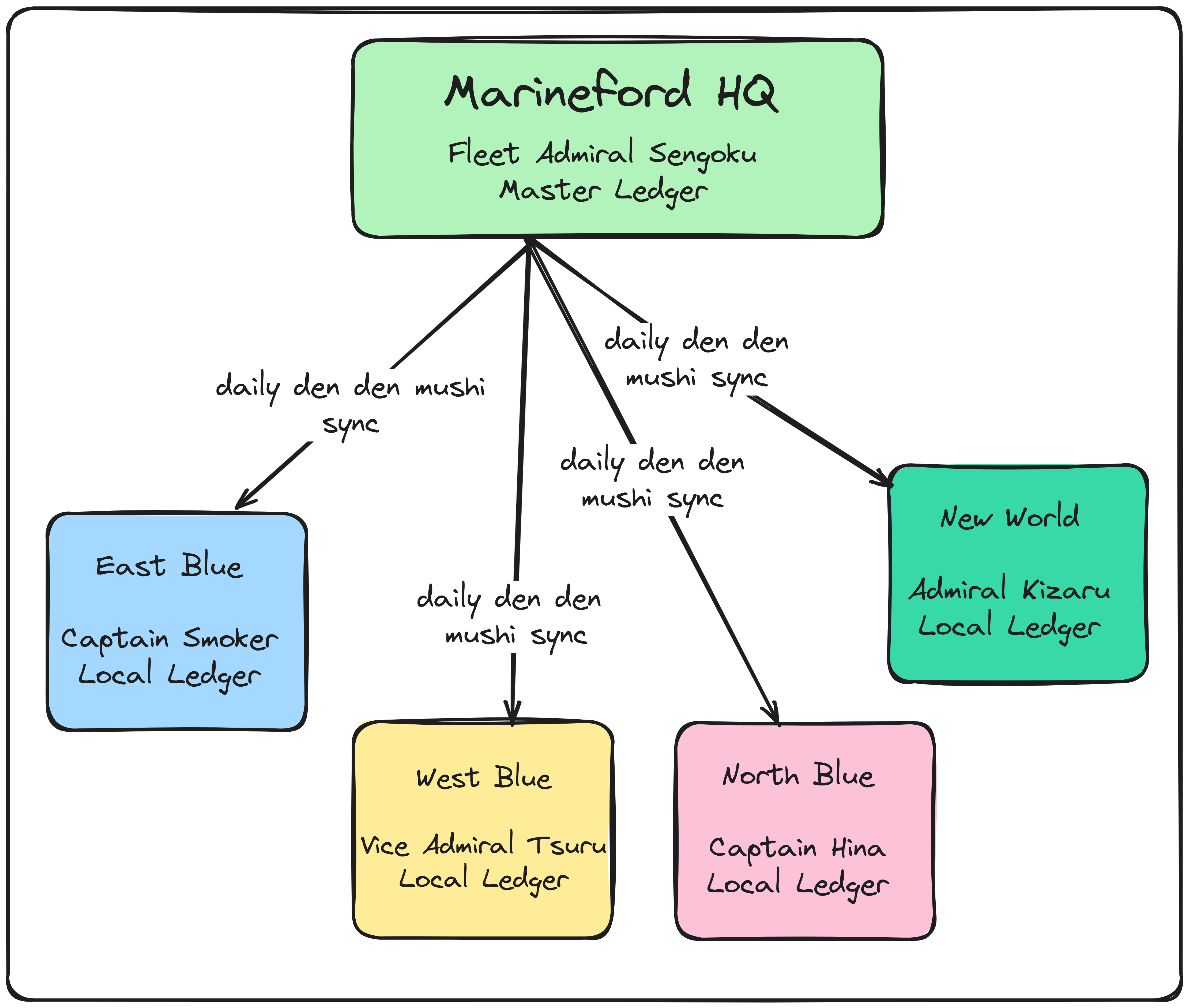 Looked great on paper. Then the problems started almost immediately.
Chapter 3: The Luffy Bounty Catastrophe - Consistency Breaks
After the Arlong Park incident, Sengoku raised Monkey D. Luffy’s bounty from zero to 30 million Berries and updated Marineford’s master ledger. The update would reach all regional bases in the next day’s sync.That same afternoon, just six hours seven minutes later, a bounty hunter ship in the East Blue contacted Smoker’s base asking: “What is Monkey D. Luffy’s current bounty?”
Smoker’s ledger was last synced yesterday morning. It showed: no bounty listed.The bounty hunters were told Luffy was a nobody. They dismissed him entirely and sailed past him on the open sea. Luffy escaped without even knowing he was nearly caught.The next day, when Smoker’s ledger updated to show 30 million, he was furious. “We had him. We had him right there and our own records said he didn’t exist.”
This is a consistency failure in its purest form. Two nodes in the same network gave completely different answers about the same pirate at the same moment. The daily sync was too slow. The gap between writes and reads was exactly long enough to cause damage.
Chapter 4: Sengoku’s Fix - The Buster Call Confirmation Rule.
Sengoku had seen enough. He issued Special Order 09: for any bounty query about a pirate ranked above 50 million Berries, the responding base must first confirm with at least two other bases before giving an answer. All three ledgers must agree before the information is shared. It worked beautifully for consistency. Call Smoker about Luffy, Smoker pings Marineford and Kizaru, all three confirm 100 million, bounty hunter gets the correct answer.
But then came the Marineford War.Kizaru’s entire New World base was pulled into active combat. Every operator was on deck. No one was answering the Den Den Mushi. For three full days, any base that needed to confirm a high-value bounty query had to reach Kizaru, and couldn’t.Smoker’s base received seventeen urgent bounty queries during those three days. His answer to every single one:
“I cannot confirm this information at this time. Please contact us again in 72 hours.”
Seventeen bounty hunters turned away. Seventeen pirate crews moved unchecked through the East Blue. All because one node was unreachable.
Availability: completely broken. One busy base made the whole network refuse to serve anyone.
Chapter 5: Vice Admiral Tsuru’s two-out-of-five-rule.
The legendary strategist Vice Admiral Tsuru proposed a smarter protocol. Instead of requiring all bases to confirm, require only three out of five. A majority, not unanimity.
Now if Kizaru’s base was in battle, Smoker could still confirm with Marineford, Hina, and Tsuru herself three out of five and serve the answer confidently. The system stayed alive.
But Tsuru was completely honest about the tradeoff: “There will be a short window after an update where only two or three bases know the new information. If someone queries one of the two bases that haven’t received it yet, they get an older answer. We are trading a brief moment of inconsistency for continuous availability.”
Sengoku asked: “How brief?”
Tsuru replied: “Usually minutes. Occasionally an hour. Almost never longer, and we can tune this depending on how fast we push updates.”
This is exactly how quorum-based systems like Apache Cassandra work. You define your consistency level per query, sometimes you want all nodes to agree, sometimes a majority is enough, sometimes one node’s answer will do. The dial is always in your hands.
Chapter 6: The Sea Prism Stone Blackout - True Partition.
Everything was humming along when the unthinkable happened. An unknown organization, later revealed to be working for Donquixote Doflamingo deployed enormous Sea Prism Stone emitters across the New World, creating a total Den Den Mushi blackout for an entire week.
No snail call crossed in or out of the New World during those seven days. This is the critical difference from before: this time, all bases were fully operational. No one was sick, no one was in battle. But the network between them was severed.
This is a network partition the defining crisis of any distributed system.
During those seven days:
- Luffy defeated Doflamingo at Dressrosa. His bounty should jump from 400 million to 500 million Berries.
- Marineford processed the update. Their ledger: 500 million.
- Kizaru’s New World base: completely cut off, still showing 400 million.
- A rival pirate crew called Kizaru’s base and asked about Luffy. They were told 400 million and concluded he wasn’t worth avoiding. They sailed straight into his path and were annihilated.
Now Tsuru faced the hardest question in distributed systems design.
Chapter 7: The impossible choice — CP or AP
During the blackout, Tsuru had to decide how Kizaru’s isolated base should behave. There were only two real options and no third path.
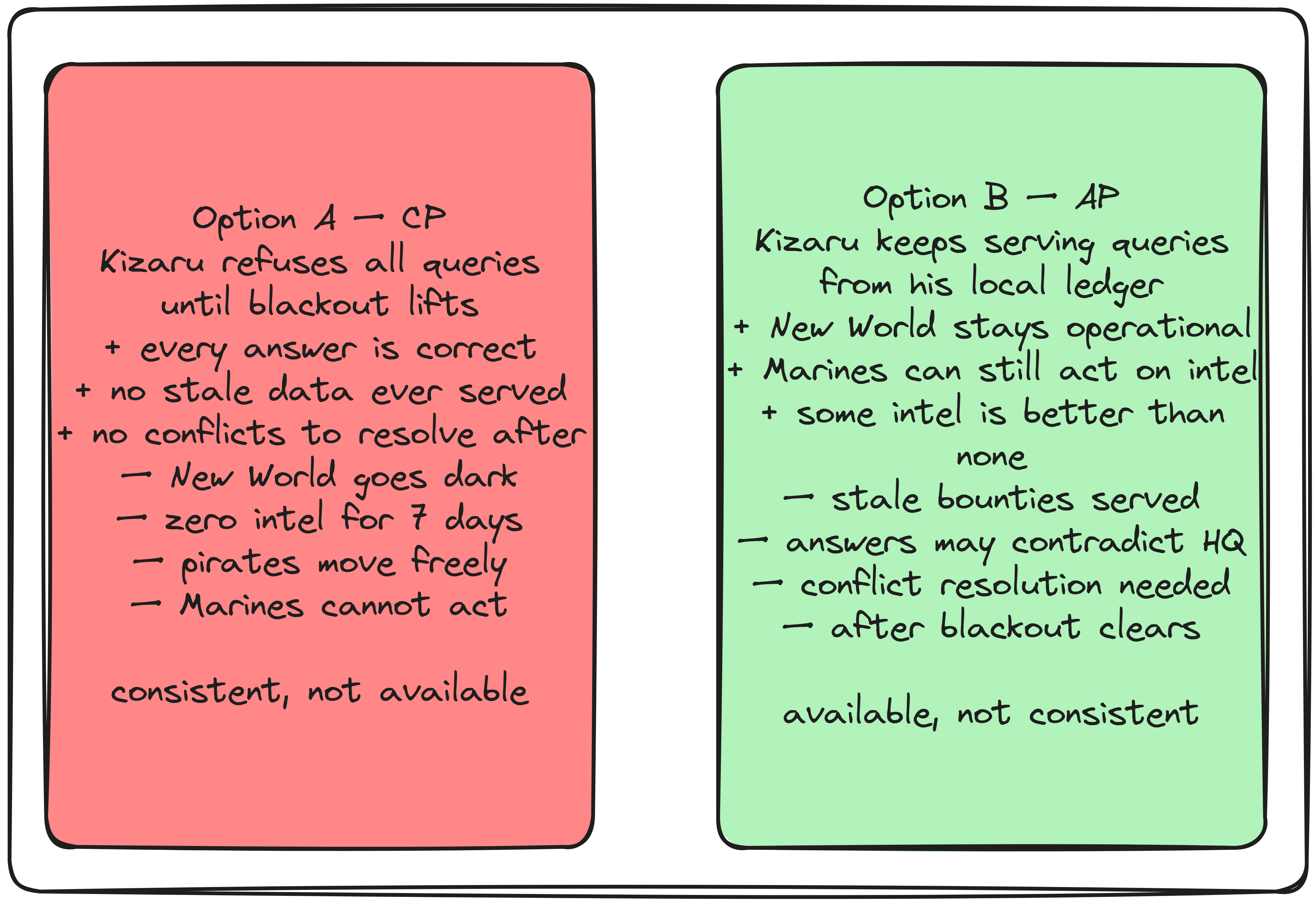
No magic third door. No clever workaround. Just a hard choice between two different kinds of pain. This is CAP theorem.
Chapter 8: When the blackout ends the conflict problem
Tsuru chose Option B. The New World stayed operational. When the Sea Prism emitters were destroyed and the Den Den Mushi signals returned, Kizaru’s operators sat down with their ledger and Marineford’s ledger side by side.
Most entries were fine untouched during the blackout. But some records had been updated on both sides independently:
- Luffy’s bounty: Marineford said 500 million, Kizaru’s base said 400 million. Easy take the higher, more recent figure.
- A Warlord’s status: Marineford had revoked it during the blackout. Kizaru’s base had issued that same Warlord a mission order, treating them as active. Who do you obey?
- A pirate crew’s threat level: updated upward by Marineford after a battle report, but Kizaru’s base had marked them as neutralised based on local intelligence. Which is true?
Some conflicts had obvious answers. Others required senior officers to manually review both records and make a judgment call. Two updates were so contradictory they triggered a formal tribunal.
This is the hidden cost of AP systems nobody talks about: the partition itself lasts seven days, but the conflict resolution takes three weeks. The choice to stay available doesn’t end when the network reconnects. The bill comes later, with interest.
Chapter 9: The Poneglyphs — eventual consistency carved in stone
Now for the most beautiful distributed systems metaphor in all of One Piece.
The Ancient Kingdom faced the ultimate distributed systems problem: how do you preserve critical information across a world where any single location can be destroyed, any single keeper can be killed, and any centralized archive can be erased by those in power?
Their answer was radical. Spread the information across indestructible nodes scattered across the entire world. No single Poneglyph holds the complete picture. You must read all of them, travel to each one, and merge the data yourself to construct the full truth.The Poneglyph network is the ultimate AP + eventual consistency system:
Always available — you can read any Poneglyph at any time. No one can make them unavailable. The World Government tried burning scholars and sinking ships, but the stones themselves cannot be refused.
Partition tolerant — destroying the sea routes between islands doesn’t destroy the data. Sinking every ship in the Grand Line wouldn’t erase a single character from a Poneglyph. The nodes survive any partition.
Eventually consistent — no single Poneglyph gives you the full truth. They give you partial truths. Only when Robin travels to each one, reads every fragment, and assembles them together does the full, correct picture emerge. The system converges toward truth — but only after all nodes are visited.
Reading just one or two Poneglyphs gives you an incomplete picture like querying only two nodes before the sync is done. You might think you understand the Void Century. You’d be wrong, or at least dangerously incomplete.
Chapter 10: The World Government’s attack a distributed systems war
Here’s the final twist. The World Government’s entire strategy toward the Poneglyphs isn’t political. It is a distributed systems attack.
They cannot delete the nodes the stones are indestructible. So instead they attack the merge operation. Kill every scholar who can read the ancient language. Sink every ship attempting to travel between nodes. Destroy Ohara, the one place where people were close to completing the read-all-nodes operation.
They don’t need to destroy the data. They just need to prevent eventual consistency from ever arriving. Keep the nodes permanently unread. Keep the fragments permanently unmerged. As long as no one can visit all the nodes and merge the results, the truth never converges and their power is safe.
Robin is the last person alive who can execute the merge. The entire second half of One Piece is, at its core, about whether an eventually consistent distributed system can complete its convergence before the adversary shuts down the last node that can read it.
Conclusion
The Marine network is a CP system struggling to be available, it wants to be correct above all else, and pays for it in uptime whenever a node goes silent.
The Poneglyph network is a pure AP + eventual consistency system, always available, always surviving partitions, but delivering the complete truth only at the end, when every node has finally been read and merged.
And the World Government sits in the middle desperate to prevent that final merge from ever happening. Because in distributed systems, as in One Piece, the real power lies in whoever controls what gets to converge.
If you made it this far, I hope CAP Theorem feels a little less abstract now. I’m currently learning distributed systems myself, and I’ll be writing more blogs like this as I explore the space and try to understand these concepts better. If you enjoyed this one, there’s more coming.